Project Statement & Bibliography
The Unspoken Rules of Sharing Food
Sharing food seems ordinary, yet it is shaped by rules no one says out loud. Who takes the last piece? When should food be offered to someone else? Why can the same gesture feel polite in one situation and rude in another? My enquiry began with a moment of hesitation. When shared food is nearly finished, people stop reaching for it and start offering it instead. I realised that “the last piece” is rarely just the final piece. Hesitation can begin while several bites remain, as people weigh others’ appetites against the risk of appearing selfish.
Mary Douglas’s Deciphering a Meal (1972) gave me a way to read food as social communication, through which relationships, boundaries and cultural expectations are expressed. It led me to ask how fairness, politeness and consideration shape the way shared food is distributed.
I first explored these interactions through a bread zine and a rotating table prototype, testing ways to represent and physically experience sharing. I then surveyed 31 participants. Their responses varied across relationships and situations, but 30 agreed that unspoken rules exist when eating together. This shifted my enquiry from a single behaviour towards a wider system of social expectations.
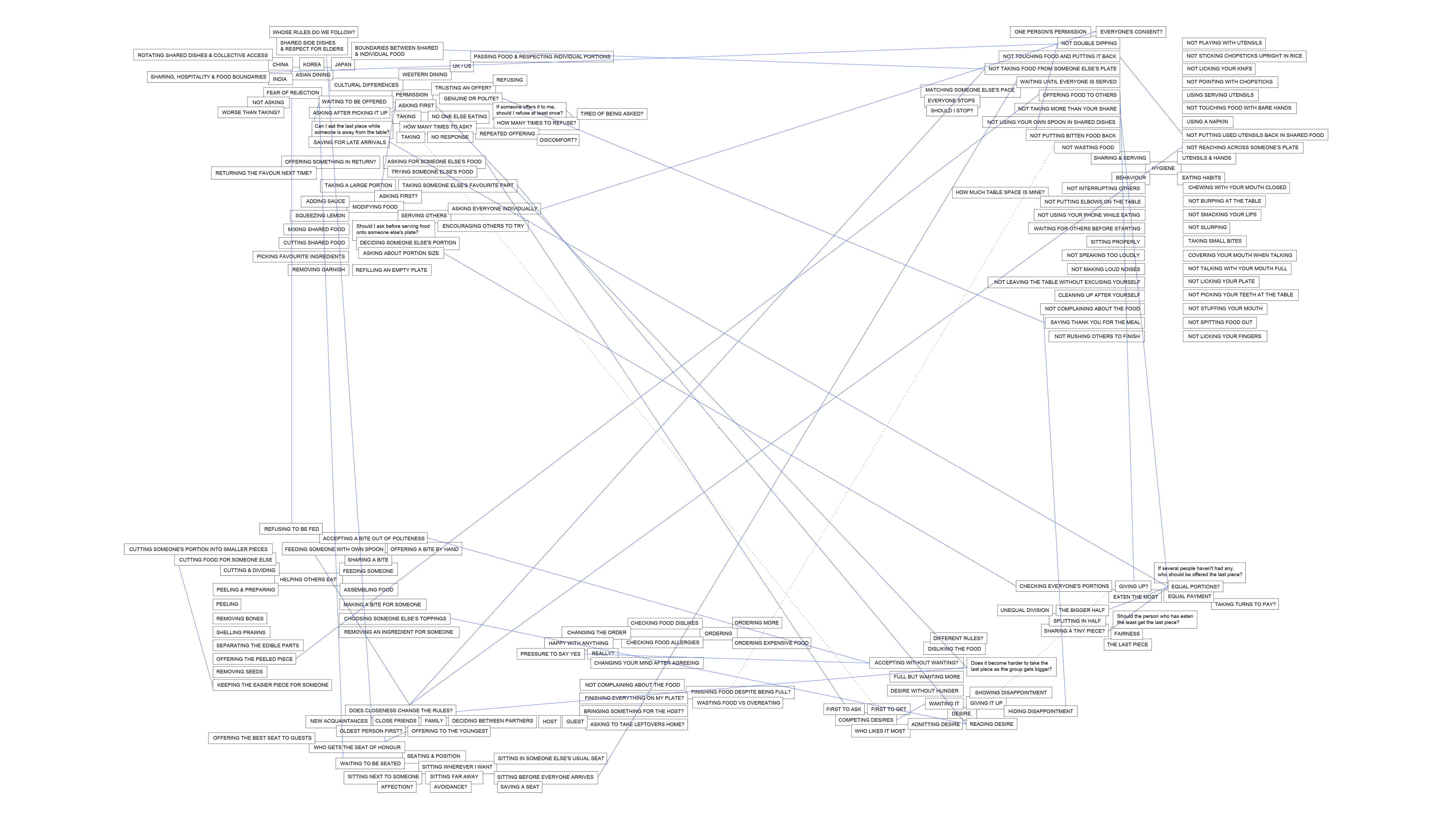
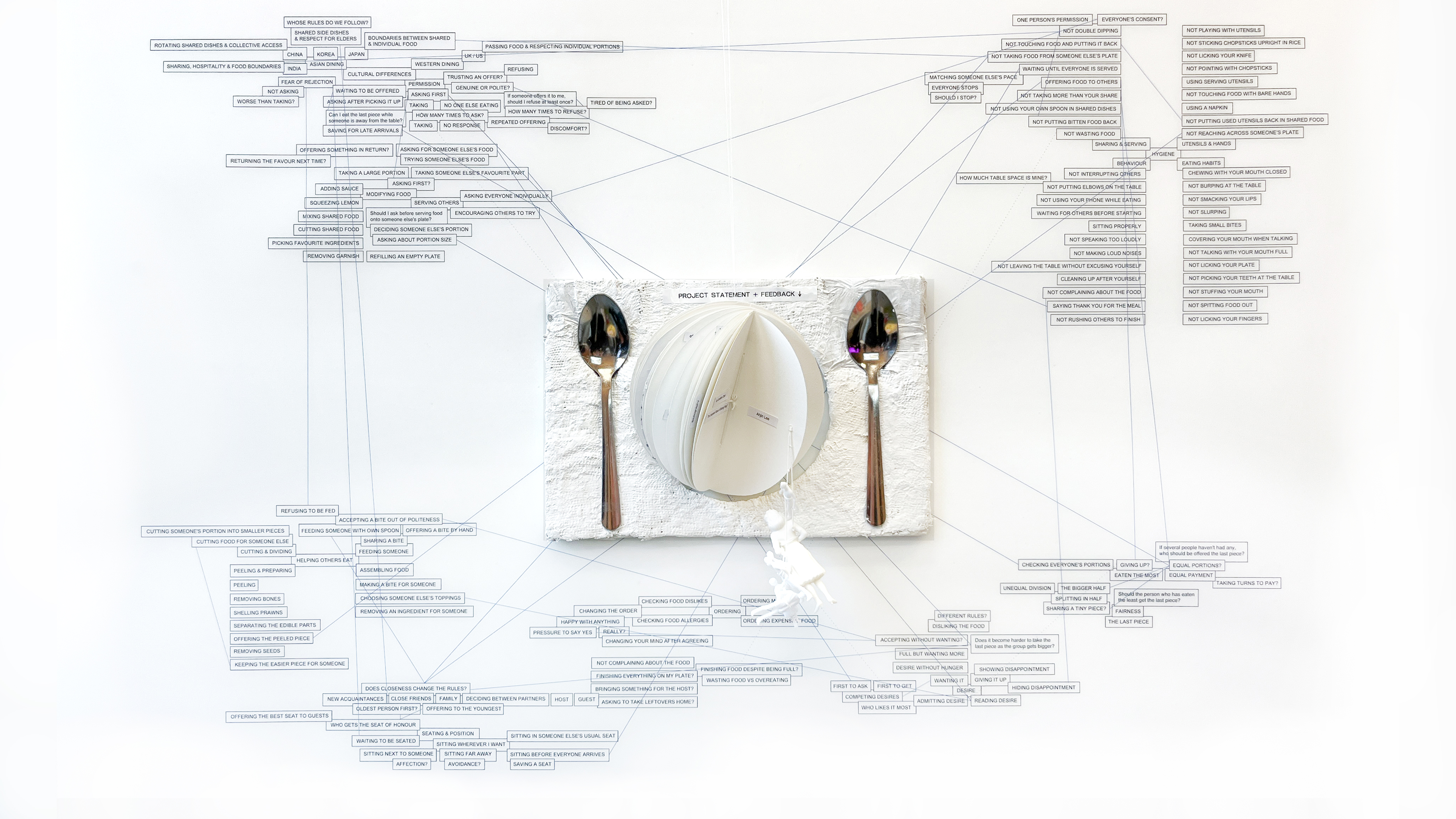
Using the survey findings, I developed a pizza prototype to visualise these rules, then collected and categorised them, looking for connections and contradictions. My first idea was a guidebook, but reflection made me question whether instructions would imply fixed answers to behaviours that depend on context. Yoko Ono’s instruction pieces and Alison Knowles’s event scores offered a useful contrast to that idea. Their instructions open up everyday actions rather than prescribe the correct way to perform them, which confirmed my decision to move away from telling people what to do. I instead developed a large-scale information map that could hold conflicting expectations together without resolving them.
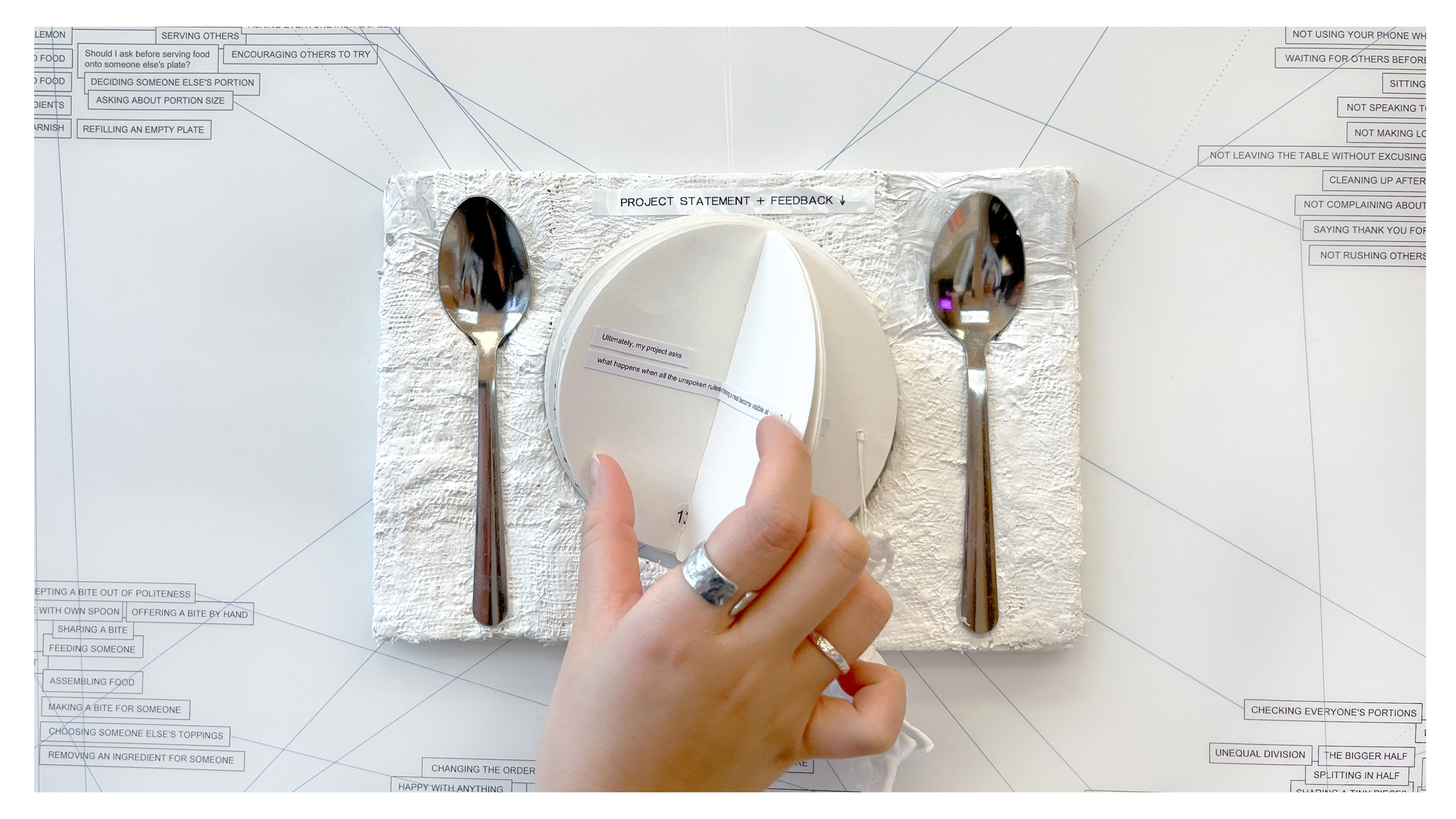
The final outcome is an A2 information map. From a distance, its density of text, lines and symbols feels overwhelming. Up close, individual rules and their connections become readable. This complexity is intentional, as navigating the map echoes the difficulty of recognising the expectations at work during a shared meal.
My intended audience is anyone who shares meals with others and may follow these expectations without noticing them. Rather than teaching etiquette, the map invites viewers to recognise familiar situations, compare them with their own experience and question what they take for granted.
In relation to social justice, the project asks whose expectations come to be accepted as normal. What feels considerate to one person may feel obligatory or exclusionary to another, depending on relationships, culture and social position. My research cannot establish universal rules. Instead, it shows the limits of treating shared eating as one consistent experience.
This leads to the question at the heart of my project.
WHAT HAPPENS WHEN ALL THE UNSPOKEN RULES OF SHARING A MEAL BECOME VISIBLE AT ONCE?
Bibliography
Douglas, M. (1972). Deciphering a meal. Daedalus, 101(1), pp. 61–81.
Jaarsma, M. I Eat You Eat Me (2001) Available at: http://mellajaarsma.com/installation/i-eat-you-eat-me/ (Accessed: 12 Oct 2026).
Kim, H. (2015) Pizzas for the People. 6 Feb 2015, Available at: https://www.youtube.com/watch?v=od5XoQFxxWo (Accessed: 12 Oct 2026).
Knowles, A. (2012) Make a Salad [Installation] at the High Line in 2012.
Lupi, G. (2017) Data humanism: a visual manifesto. Available at: https://giorgialupi.com/data-humanism-my-manifesto-for-a-new-data-wold (Accessed: 4 November 2026).
Ono, Y. (1964) Grapefruit. 1st edn. Wunternaum Press.
The Vegetable Orchestra (n.d.) The Vegetable Orchestra. Available at: https://www.vegetableorchestra.org/ (Accessed: 15 October 2026).